


There is a version of this article that leads with a breathless claim about AI replacing the sales force. That is not this article. Instead, we’ll take a realistic look at how an AI voice agent for marketing is shaping new strategies and supporting real teams.
What this article is about is something more specific and more useful: why the phone call, executed with genuine intelligence, is still the highest-converting touchpoint in direct response marketing, and why most teams are badly underusing it.
If you run lead generation campaigns that depend on getting a prospect from interest to action, this matters to you. It does not matter whether you are a brand managing campaigns in-house, an agency juggling dozens of client programs, or a mail house trying to prove your print investments still close deals. The underlying problem is the same.
And it has a better answer than most people realize.
The Death of the Cold Blast
For about two decades, direct response marketing operated on a simple model: reach as many people as possible and let volume do the work. Send enough mail. Run enough impressions. Blast enough emails. Some percentage would convert, and if your math was right, the program was profitable.
That model has not collapsed. But it has gotten significantly more expensive and significantly less reliable. Postage costs have risen. Email inboxes are more contested than ever. Digital CPMs keep climbing. And consumers, having been blasted from every direction for twenty years, have grown better at ignoring things that do not feel relevant to them.
The response to this, for most organizations, has been to do more of the same with better targeting. Smarter list selection. Better lookalike audiences. More sophisticated holdout testing. All of that helps. None of it changes the fundamental dynamic: you are still broadcasting, and your prospect is still deciding whether to pay attention.
What the best-performing programs are discovering is that the real opportunity is not in reaching more people. It is in converting the ones you have already reached.
Most direct response and lead generation programs tend to have a conversion problem. A prospect who responds to your campaign is raising their hand. What happens in the next few minutes determines whether that signal turns into a sale.
The critical insight here is who initiates the conversation. In a well-structured direct response campaign, the prospect moves first. They scan a QR code on a mail piece, click a link in an email, or respond to a digital ad. That action is the signal. The voice agent’s job is to respond to it immediately, intelligently, and with full context about what prompted it. This is not a cold call. It is a warm conversation that the prospect started.
What “Intelligent” Actually Means in a Voice Call
When people hear “AI voice agent,” they usually think of one of two things: the robocall that plays a recording when you pick up, or the IVR tree that sends you in circles before you give up and hang up. Both have earned their terrible reputations. Both are also outbound, unsolicited, and context-free.
That is not what we are talking about.
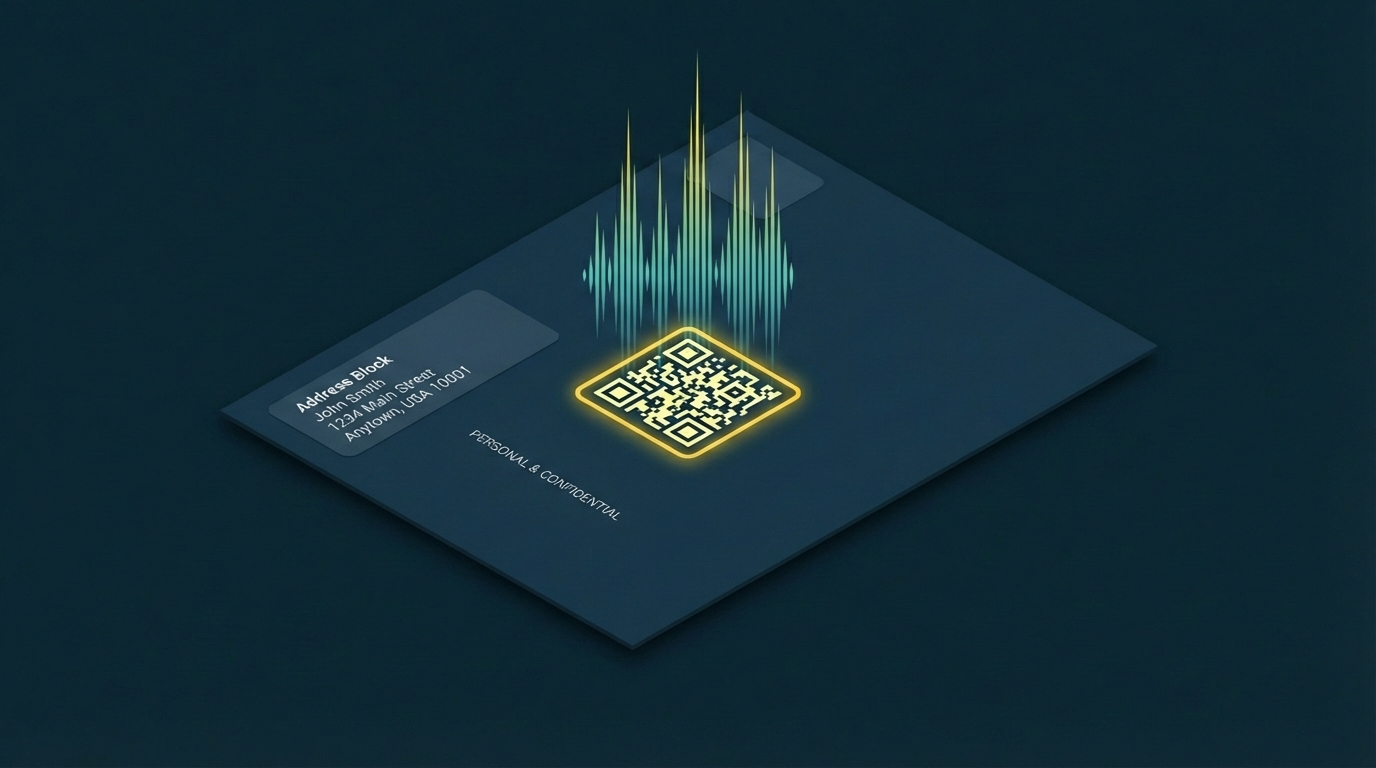
In a direct response context, the conversation starts with the prospect. Someone receives a personalized direct mail piece and scans the pQR code printed on it. Someone clicks a link in an email. Someone taps through on a digital ad. That action triggers the voice agent immediately, with the prospect’s identity, their campaign touchpoint, and their relevant history already loaded into the conversation before a single word is spoken.
The distinction matters. A prospect who scanned a QR code on a mail piece about their home equity options is not a cold prospect. They are a warm one who just told you exactly what they are interested in. An intelligent voice agent responds to that signal the way a great sales rep would: “Hi Sarah, I see you just came through on our home equity offer. I’d love to answer any questions and see if we can find you the right fit.” It does not read a script. It responds to a person, with context, in real time.
Time from pQR code scan or ad click to a live personalized conversation
Of inbound signals answered, with full campaign and prospect context loaded
Improvement in appointment set rates vs. a control group running the same mailer without voice AI — all inbound, no cold dialing
The economics shift entirely when every inbound signal gets an immediate, personalized response. A prospect who scanned a QR code and connected with an agent that already knew their name and their offer is a fundamentally different conversion opportunity from one who filled out a form and waited two days for a follow-up call.
Speed matters. But intelligence matters more. Speed gets you in the door. Intelligence is what happens once you are there.
Real-Time Sentiment: The Unfair Advantage
Every experienced sales rep will tell you that listening is more important than talking. They read the room. They hear hesitation before it turns into an objection. They pick up on warmth and lean into it. They know when to slow down and when to push. That attunement is what separates a conversation from a pitch.
Real-time sentiment analysis gives an AI voice agent the same capability, running continuously throughout the call.
The agent is reading tone, pacing, word choice, and pause patterns in real time. Not after the call, not in a post-conversation report, but as the conversation is happening. If a prospect’s tone shifts toward frustration, the agent adjusts. If engagement picks up when a particular feature is mentioned, the agent notices and develops that thread. If someone says “I’m actually really interested but I need to check with my partner,” the agent hears the intent in that and responds to the intent, not just the words.
How It Works
Boostt AI’s voice agent reads 4 real-time signals throughout every call. These signals update the conversation model continuously, so the agent is never locked into a script that no longer fits the moment.
This is where AI voice agents start to do something that human reps frequently cannot do at scale: perform consistently. A human rep at 4pm on a Friday after a long week is not the same as that rep on a Tuesday morning at 10am. Their reads are less sharp. Their energy is lower. They miss signals they would normally catch. An AI agent performs the same way on every call. That consistency, across thousands of calls, is where the aggregate performance advantage compounds.
It also changes what you do with the calls where sentiment goes sideways. If a prospect is frustrated, the agent can attempt to de-escalate. If that is not working, it transfers to a human rep, warm, with a summary of what just happened. The human does not start from scratch. They start with context, and they start at the right moment.
From the Call to the Journey: The Boostt AI SignalStackTM
Most teams think about a voice call as a contained event. Someone picks up, a conversation happens, the call ends, a disposition is logged. That is where the thinking stops.
The more useful way to think about a voice call is as a rich source of behavioral signal that should be informing everything that happens next in your marketing sequence.
Every call generates data: did the prospect pick up, how long did they stay on, what were they interested in, what objections came up, did they book an appointment, did they ask to be called back, did they say they were not interested. These are not just metrics for a dashboard. They are signals that should be triggering specific actions downstream.
- A prospect who expressed interest but did not book enters a retargeting sequence with addressable display ads featuring the specific product they responded to
- A prospect who booked an appointment gets a confirmation sequence and a reminder the day before
- A prospect who asked for more information gets a follow-up email with the relevant collateral within the hour
- A prospect who said they were not interested right now gets a suppression flag so they are not called again for 90 days
- A prospect who transferred to a human and did not close enters a long-tail nurture sequence
This is what a SignalStackTM does. It takes the output of a voice conversation and routes it intelligently into your broader journey orchestration. The call is not the end of the sequence. In most cases, it is the beginning of a much more targeted one.
Boostt AI’s journey orchestration connects those call signals directly to retargeting, email, and downstream campaign actions. The voice agent is not a standalone tool. It is the front end of a coordinated follow-up system.
How Brands, Agencies, and Mail Houses Each Win Differently
The same underlying capability plays out differently depending on who is running it and what they are trying to accomplish.
Brands & In-House Teams
Contact rate and speed. Leads that used to go cold before a rep called are now reached in minutes, with full context from CRM and account data loaded before the first word is spoken. CPL comes down. Attribution gets clearer.
Performance Agencies
A differentiated service line. Agencies that run voice AI across multiple clients own a capability their competitors do not have. It is a new revenue stream, a stronger client retention story, and a result their clients cannot get anywhere else.
Mail Houses & Print Direct Respons Partners
Closing the conversion gap. A prospect who scans the personalized QR code on a mail piece connects instantly to a voice agent that already knows the campaign, the offer, and their name. Clients stop questioning print ROI when they can see the full chain from scan to appointment.
The common thread across all three is that conversational AI works best as a response mechanism, not a broadcast one. The prospect initiates. The agent responds with everything it needs to have a real conversation. The campaign converts at a rate that no form fill or email sequence can match on its own.
What to Look For in a Conversational AI Partner
If you are evaluating voice AI for a direct response program, there are five questions worth asking before you commit to anything.
Does the agent have access to your data at the moment of contact? If the answer is no, it is not personalizing. It is templating. There is a significant difference between an agent that says “Hi Sarah” and one that says “Hi Sarah, I see you just scanned the QR code on our home equity mailer. I’d love to walk you through what that offer means for your situation.” One is a mail merge. The other is a conversation. The pQR code or ad click that triggered the call should be surfacing the prospect’s full context before the first word is spoken.
How does it handle objections and intent signals? Any agent can follow a script. The question is what it does when the conversation goes off-script. Does it have a framework for reading where the prospect is and adapting? Can it escalate to a human when that is the right call?
What happens after the call? A voice call that generates no downstream signal is a missed opportunity. Ask how call outcomes feed into your retargeting and journey sequences. If the answer is “we send you a disposition report,” that is not integration. That is a spreadsheet.
How is compliance handled? The FCC’s 2024 ruling on AI-generated voice calls changed the landscape. Prior express written consent, DNC compliance, and call recording rules are not optional. Your partner should be checking these before every dial, not leaving it to you to manage.
Can you see what is working? Contact rate, set rate, show rate, conversion rate. These should all be visible, attributable, and comparable to your control group. If you cannot measure it, you cannot improve it.
Checklist
The Boostt AI Checklist
Here is what a well-built voice AI program should include, regardless of which platform you use:
- CRM and database access during the call, so personalization is real, not simulated
- Real-time sentiment analysis that adapts the conversation as it happens
- Live call transfer capability, with warm handoff context for the receiving rep
- Appointment setting that syncs directly to your calendar and CRM
- Signal stack integration that routes call outcomes into your downstream journey
- TCPA and DNC compliance verification before every dial
- Full campaign reporting with contact rate, set rate, and conversion attribution
The Conversation Is the Campaign
The shift that intelligent voice AI represents is not really about technology. It is about what you believe a conversation can do in a marketing sequence.
For a long time, the phone call has been underinvested in direct response because it was expensive to do well at scale. Human reps are the highest-quality touchpoint and the hardest to scale. Autodialers are cheap and terrible. There was not much in between.
That gap is closing. An AI voice agent that responds within seconds to a prospect’s pQR scan or ad click, arrives at the conversation already knowing who they are and what they responded to, reads the room while the conversation is happening, transfers to a human at the right moment, and fires your retargeting sequence when it ends is not a replacement for your best sales rep. It is what your best sales rep would look like if they could be everywhere at once, remember every customer perfectly, and respond in under a minute every time.
That is the version of the phone call worth betting on.
Frequently Asked Questions
Q.What is an AI voice agent in direct response marketing?
A. An AI voice agent in direct response marketing responds to inbound prospect signals — a pQR code scan on a mail piece, an email link click, or a digital ad response — with an immediate, personalized voice conversation. Unlike robocalls or IVR systems, it accesses the prospect’s CRM data and campaign context before the call begins, conducts a real conversation adapted in real time by sentiment analysis, and can transfer high-intent prospects to a human rep or book an appointment directly on the call.
Q. How does a pQR code work with an AI voice agent?
A. A personalized QR code (pQR code) on a direct mail piece is unique to each recipient. When a prospect scans it, the scan triggers the AI voice agent immediately — passing the prospect’s identity, campaign context, and account history into the conversation before it begins. The agent responds within seconds with a personalized greeting that references their name, the specific offer on the mailer, and any relevant account information. The conversation starts warm because the prospect initiated it.
Q. What is real-time sentiment analysis in a voice call?
A. Real-time sentiment analysis means the agent continuously reads four signals throughout the conversation: tone of voice, speaking pace, keyword patterns, and silence duration. Unlike post-call analysis, this happens as the conversation unfolds. If a prospect signals frustration, the agent adjusts immediately. If strong buying interest appears, the agent develops that thread or initiates a live transfer to a human closer.
Q. What is a SignalStackTM in voice AI?
A. A SignalStackTM is the set of behavioral data points generated by a voice call — whether the prospect answered, how long they stayed on, what interested them, whether they booked, or whether they asked to be called back. These signals route into downstream marketing actions automatically: retargeting sequences, appointment confirmations, email follow-ups, or suppression flags. The call is the start of a more targeted campaign sequence, not the end of it.
A. Is AI voice calling TCPA compliant?
A. It can be, when compliance is built into the platform. The FCC’s 2024 ruling requires prior express written consent for AI-generated voice calls to mobile numbers. Boostt AI recommends that you verify consent, scrub against Do-Not-Call lists, and check call recording compliance before every outbound dial. In pQR campaigns, the prospect’s act of scanning and initiating the conversation is itself a consent signal, subject to proper opt-in language in campaign materials.
A. What results can direct response marketers expect from adding AI voice to a mail campaign?
A. In a documented Boostt AI campaign, a financial planning firm running 40,000 direct mail pieces saw a 4x improvement in appointment set rates compared to a simultaneous control group running the same mailer without voice AI. Both groups received identical mail. The test group added two inbound response paths: a pQR code triggering an immediate personalized conversation, and a printed number routing through the same context-loaded agent. No outbound dialing was used.