

Growth strategy

Physical intelligence: the growth signal your digital stack can't see

Your mailer gets handled 4.5 times over 8 days by more than one person in the house. Your best-performing ad gets 1.7 seconds. One of those is measured obsessively. The other one is where the memory gets made.

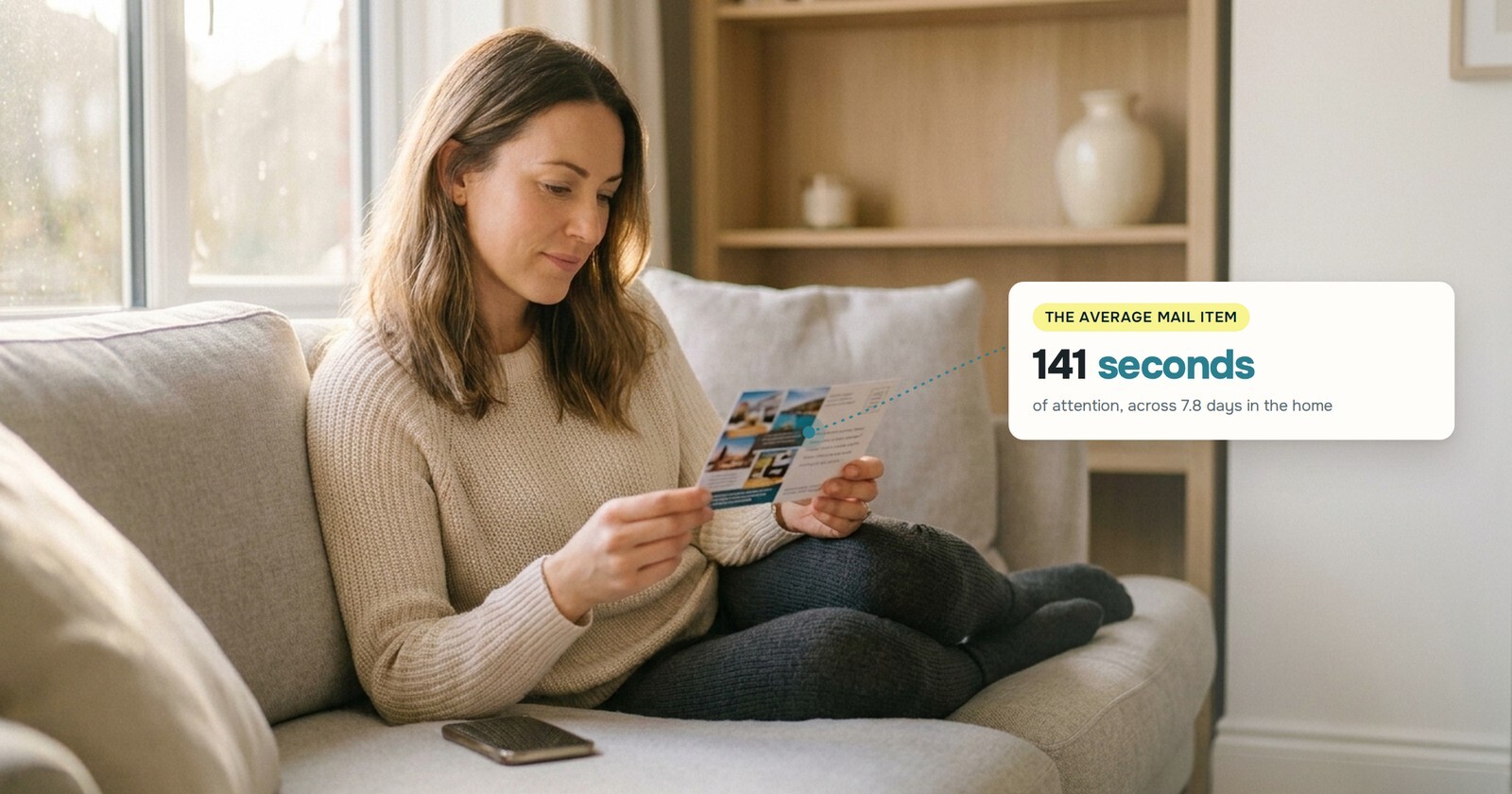
A woman sits on a couch reading a marketing postcard. A callout reads: the average mail item, 141 seconds of attention, across 7.8 days in the home.
The average mail item collects 141 seconds of attention across 7.8 days in the home. Source: JICMAIL item data, Q1 2026.

One direct mail item · one household · 28 tracked days

In home, 7.8 days 4.5 handling events After disposal 141s attention 1.14 people reached

On the 7.8 days. JICMAIL averages every item delivered, including mail binned on arrival, and stops the clock the moment an item is filed away. The widely quoted 17-day figure counts only mail people chose to keep (Kantar TGI, 2014). We use the conservative number throughout.

Every growth review we sit in lands on the same slide eventually. CPMs up. Conversion rate flat. The fix is more creative variants, tighter audiences, a fresh hook format for the same nine seconds of feed.

Nobody in those rooms is wrong, exactly. They're working inside a box that somebody else built and priced. The platforms report their own performance, set their own floor, and quietly define what counts as a channel at all. Anything outside that definition gets filed under brand spend and cut first when the quarter tightens. Which is how a piece of media that lands in someone's hand, sits on the counter for a week, gets picked up four or five times by two different people, and then sends them to your website ended up on the same line as the trade show booth. We're not making a nostalgia argument. Physical media produces data. Rich, panel-verified, behavioral data about how humans actually handle an object over time. Most brands simply never instrument it, so they can't see it, so they conclude it isn't there.
Physical earns the memory. Digital supplies the frequency. The conversation converts the moment where the two of them land at once.

The pressure

The box is getting more expensive every quarter

Meta CPMs hit an all-time high of $22.98 in Q4 2025, with November peaking north of $25 in the Black Friday crush, per Varos benchmarking across 6,000+ companies. Cost per lead rose about 21% year over year while conversion rates slipped. Zoom out and ecommerce acquisition costs climbed somewhere between 40% and 60% from 2023 to 2025. That doesn't mean digital stopped working. It means the marginal dollar buys less than it did, and every competitor is bidding into the same inventory with the same creative playbook and, increasingly, the same automated bidding engine deciding for them. Thinking widely isn't sentimentality about old channels. It's looking for advantage in places the auction doesn't price.

Evidence · Industry currency

What physical intelligence actually measures

Definition

Physical intelligence is the measurable record of how people handle a tactile marketing asset over time: how often they pick it up, how long they hold it, how many people in the household see it, how many days it survives, and which digital actions it triggers afterwards.
JICMAIL is the UK's joint industry currency for mail. It panels households and logs every single interaction with every single item across a 28-day window, the same way TV audiences get measured. Not a survey. A currency. Here's what the Q1 2026 dataset says the average direct mail item does after it arrives:
Direct mail performance, JICMAIL item data, Q1 2026
Metric Value What it buys you
Frequency of interaction 4.5 Repeat exposure without repeat media cost
Item reach 1.14 people Household reach beyond the named recipient
Lifespan in home 7.8 days A standing presence across the consideration window
Attention 141 seconds Deliberate, uninterrupted time with the message
Prompted a website visit 9.4% Measurable handoff into your digital funnel
Multiply the first two and you get roughly five human exposures per piece, plus more than two minutes of deliberate attention, spread across the better part of a week.

Does UK data travel to a US brand?

JICMAIL is a British currency, and there is no US equivalent measuring item lifespan, handling frequency or attention seconds. Every US article quoting mail longevity, including the ones citing 17 days, is ultimately quoting British research. What the US does have is the USPS Household Diary Study, run annually since 1987 across roughly 5,200 households. It measures different things and it corroborates the direction. In FY2024, US households received 410 pieces of advertising mail, 59% of advertising mail sent to existing customers was read, and recipients were considering a response to 15% of it. So treat the persistence figures as directional for a US audience rather than as a US benchmark. American households receive more advertising mail than British ones, and heavier clutter would compress lifespan rather than extend it. Worth noting that the rest of the evidence here is North American: the neuroscience is American and Canadian, the response and ROI benchmarks are ANA/DMA. The mechanism travels. The decimal place does not. Now price the comparison honestly. A skippable video counts a view at two seconds. A display impression counts on render. The unit of digital attention is a moment. The unit of physical attention is a tenancy. Brands rarely lose because the message was never seen. They lose because it was seen and immediately overwritten by whatever loaded next.

The dwell gap

Two media buys, twenty-eight days

Same household, same month. One of these is still on the fridge when the other one has been gone for three and a half weeks.

Direct mail item 7.8 days in home · 4.5 interactions · 141s attention
Paid social impression 1.7 seconds · 1 exposure · gone on scroll
1.7 seconds, drawn to scale
Day 0Day 7Day 14Day 21Day 28

To scale, the digital impression is 0.0007% of the tracking window. It is technically drawn on this chart. You will need to trust us on that.

Evidence · Neuroscience

Why tactile encodes better, according to brain scans

This is the part of the argument that's hard to wave away, because it isn't recall survey data. It's neuroimaging, run independently by three different institutions, pointing the same direction.

Temple University with the USPS Office of Inspector General

Researchers at Temple's Center for Neural Decision Making ran participants through eye tracking, biometrics and fMRI, comparing postcards against ads embedded in email. Digital got processed faster. Physical got processed deeper. Participants spent longer with the physical ads, showed stronger emotional response, recalled them faster and more confidently a week later, and showed greater subconscious valuation of the products advertised on paper. A follow-up study on sequencing found that a physical ad shown twice beat every other tested sequence for memory and subjective value, including the all-digital one.

Canada Post with True Impact Marketing

270 participants, EEG plus eye tracking, published as "A Bias for Action." Direct mail required 21% less cognitive effort to process than digital. Motivation response ran 20% higher. And brand recall came in at 75% against digital's 44%.

Bangor University with Millward Brown, for Royal Mail

fMRI scans showed physical materials driving more activity in the parietal regions that integrate visual and spatial information, plus more of the activity linked to internal emotional processing. Their phrasing was that tangible materials leave a deeper footprint in the brain, and that physical material reads as more real to the brain. The effect survived controlling for touch itself.

Brand recall, prompted · Canada Post / True Impact, n=270

Direct mail
75%
Digital ad
44%

Recall lift +70%  ·  Cognitive load −21%  ·  Motivation response +20%

Source: Canada Post and True Impact Marketing, "A Bias for Action," 2015. EEG and eye tracking across five mail formats and four digital formats.
Put it in commercial language. Encoding is the precondition for consideration, and consideration is the precondition for the sale. A channel that encodes 70% better isn't a branding luxury. It's a conversion input that shows up three weeks later as a branded search you'll happily attribute to Google.

Evidence · Behavior

The journey a mail piece starts is a digital one

Here's where most brands read the channel backwards. They treat physical as a destination. It's an opening move. JICMAIL's Q1 2026 numbers: 9.4% of mail items prompted a visit to the advertiser's website, a first-quarter record. Around 6% of mail prompts a purchase, and 56% of those mail-driven purchases got completed online, the highest share since tracking started. So the dominant outcome of a physical touch is a digital action. The mailer isn't competing with your site, your flows or your retargeting pools. It's loading them, with intent that didn't exist in the household 48 hours earlier. Which makes "does direct mail beat paid social" the wrong question. The useful one is what happens to your digital performance when a physical touch is running underneath it.
MAIL LANDS 7.8 days in home SITE VISIT 9.4% of items RESPONSE MOMENT scan or call, intent peaks SIGNAL STACK 56% purchase online PHYSICAL CONVERSATION DIGITAL
Source: JICMAIL Item Data, Q1 2026. Response moment is where the physical signal either converts or evaporates.

Evidence · Integration

What happens when you run both at once

Canada Post went back with Ipsos and Neurons Inc. to test integrated campaigns against single-media digital, published as "Connecting for Action." People paid 39% more attention to campaigns that combined mail and digital than to digital alone. Brand recall ran 40% higher when the mail arrived after the email. Sequence mattered, which is the finding most people skip. Mail performed strongest as the follow-up, not the opener. It works less like an awareness buy and more like the thing that moves someone from interested to acting.
+0%

More attention paid to integrated mail and digital campaigns than to digital-only campaigns.

+0%

Higher brand recall when the direct mail piece followed the email, rather than leading.

Source: Canada Post with Ipsos and Neurons Inc., "Connecting for Action," 2016.
The response economics agree. The ANA/DMA Response Rate Report puts average direct mail response at 4.4% against email's 0.12%, and house-list mail delivers the highest ROI of any paid channel it measures at 161%.

The gap

Where these integrations usually fall apart

Most brands that try this stop at coordination. Mail drops Tuesday, email goes Thursday, a match file builds a retargeting pool. That's a shared calendar, not intelligence. Intelligence means the physical interaction generates a signal and the signal changes what happens next. Think about the response moment specifically. Someone scans a code on a piece that's been sitting on their counter for six days. They've handled it four times. Their partner has read it too. At that exact second they are the warmest prospect in your entire file, and what you do in the next 60 seconds decides whether the physical investment converts or quietly dissolves. Most brands answer that moment with a form.

What we built

Answering the response moment with a conversation

Boostt AI's voice agent exists for that 60 seconds. A personalized QR code on the mail piece triggers an immediate voice conversation with the prospect's name, history and offer already loaded. A printed number routes callers through the same agent with the same context. It reads tone, pace and hesitation live, adapts, books the appointment or transfers to a human when intent spikes, then pushes the outcome into the signal stack so retargeting, email and social carry the journey forward. On a financial services campaign across 40,000 mailers, that produced a 4× improvement in appointment set rates against a control group running at the same time. Same list, same mailer, same window. The only variable was what met the prospect at the response moment. No outbound dialing anywhere in it. Every conversation was started by the recipient.

Appointment set rate, indexed · 40,000 mailers, simultaneous control

Control group
With voice agent

Same list · same creative · same drop window · inbound response only

Source: Boostt AI client campaign, financial services. Control group ran the identical mailer without the voice agent in the response path.
For an ecommerce or B2C brand the same mechanic maps onto anything where the decision is worth more than a checkout page can carry: high-AOV categories, subscription saves, replenishment, considered purchases, win-back on lapsed buyers.

How to run it

Five things that make this work in practice

  1. Instrument the physical layer before you scale it. Personalized QR codes, unique numbers, match-back files. Without them the piece is an unmeasured cost, which is why it keeps losing budget arguments to channels that grade their own homework.
  2. Sequence on purpose. The recall advantage is biggest when physical follows digital. Prime with paid social and email, land the piece, then retarget while it's still on the counter.
  3. Plan against 28 days, not the drop date. A 7-day attribution window will systematically undercount a channel that lives for 8 days and gets handled five times. You're not measuring the channel, you're measuring your window.
  4. Answer the response moment with a conversation. A form asks your warmest prospect of the month to do more work. A conversation does the work for them, and tells you why they hesitated.
  5. Feed every physical signal back into digital. A scan, a call, a sentiment read, an objection someone raised out loud. Each one is a targeting input your competitors bidding into the same auction genuinely do not have.

Common questions

Physical intelligence, answered

What is physical intelligence in marketing?Physical intelligence is the measurable record of how people interact with a tactile marketing asset over time. It covers frequency of handling, seconds of attention, how many household members are reached, how many days the item survives in the home, and the digital actions it triggers afterwards. Mail currencies such as JICMAIL track these behaviors on panels the same way TV audiences are measured.
Why does direct mail have higher brand recall than digital advertising?Because the brain encodes tangible material more deeply. Canada Post's EEG study with True Impact Marketing recorded brand recall of 75% for direct mail against 44% for digital, a 70% lift, alongside 21% lower cognitive load. Separate fMRI work by Bangor University and Millward Brown found physical materials produce more activity in regions handling spatial integration and internal emotional response, which is what turns exposure into memory.
How long does a direct mail piece stay in the home?7.8 days on average, per JICMAIL item data for Q1 2026. During that window the item is handled about 4.5 times and seen by 1.14 people in the household, accumulating roughly 141 seconds of physical attention. Business mail lasts longer at around 9.1 days, while door drops average 5.6 days.
How much lift comes from combining direct mail with digital campaigns?Canada Post's "Connecting for Action" study with Ipsos and Neurons Inc. found people paid 39% more attention to integrated mail and digital campaigns than to digital-only campaigns, and brand recall ran 40% higher when the mail piece arrived after the email rather than before it. Sequence matters: mail performs strongest as the follow-up, not the opener.
What percentage of direct mail drives a website visit?9.4% of mail items prompted a visit to the advertiser's website in Q1 2026, a first-quarter record according to JICMAIL. Around 6% of mail prompts a purchase, and 56% of those mail-driven purchases are completed online. The most common outcome of a physical touch is a digital action.
What is the average direct mail response rate compared with email?The ANA/DMA Response Rate Report puts average direct mail response at 4.4% against 0.12% for email. House lists typically run 5% to 9%, prospect lists 2% to 4.4%. Direct mail to a house list also returns the highest ROI of any paid channel the report measures, at 161%. Cost per contact is higher, so the comparison that matters is ROI against your own margin.
Is direct mail worth it for ecommerce brands with rising acquisition costs?It is worth testing when digital efficiency is falling and your margin supports the per-piece cost. Meta CPMs hit an all-time high of $22.98 in Q4 2025 and ecommerce acquisition costs rose 40% to 60% between 2023 and 2025. Physical media is priced outside that auction, and it feeds the digital channels you already run rather than competing with them. Start with high-AOV segments, replenishment and lapsed-customer win-back.
Why do some sources say direct mail stays in the home for 17 days?Because that figure measures only the mail people chose to keep. It comes from Royal Mail's Private Life of Mail, citing a 2014 Kantar TGI survey in which 80% of adults had kept relevant mail in the previous four weeks, holding advertising mail for 17 days, door drops for 38 and bills for 45. JICMAIL's 7.8 days is a different construct: it averages every item delivered, including mail discarded on arrival, and ends the count when an item is filed away rather than when it is finally thrown out. The survey figure is also self-reported and twelve years old.
Is UK mail data relevant for US brands?Directionally yes, as a benchmark no. JICMAIL is the only industry currency anywhere that measures item lifespan, handling frequency and attention seconds, so US mail longevity claims trace back to British research either way. The US equivalent, the USPS Household Diary Study, measures volume and reading behavior instead: 410 pieces of advertising mail per household in FY2024, with 59% of mail to existing customers read. Use the UK figures for the mechanism and your own match-back data for the benchmark. The neuroscience and the response rate benchmarks cited here are North American.
What is the response moment, and why does it decide the campaign?The response moment is the 60 seconds after someone scans the code or dials the number on a physical piece. By then they have usually handled the item several times over several days, so intent is at its peak. Answering with a static form asks your warmest prospect to do more work. Answering with a live, personalized conversation converts the intent while it exists and captures why anyone who hesitated did so.

The wider point

Stop letting the platforms define the funnel

The brands that outgrow their category over the next three years won't be the ones who found a cheaper CPM. Everyone gets the same auction. They'll be the ones who stopped accepting a definition of the customer journey written by the companies selling the inventory. Physical earns attention and makes the memory. Digital delivers frequency and speed. A real conversation converts the moment where both of them land. Measure the three together and you have a journey you own rather than rent.

Your mailer lands Tuesday. What answers on Wednesday?

See how brands turn the response moment into a live, personalized conversation, and how the signal keeps working long after the call ends. See it at boostt.ai

Sources

  1. JICMAIL Item Data, Q1 2026, reported via Digital Printer. digitalprintermag.co.uk
  2. JICMAIL methodology and metric definitions. jicmail.org.uk
  3. Temple University Center for Neural Decision Making with USPS OIG, "Enhancing the Value of Mail: The Human Response." uspsdelivers.com
  4. USPS OIG, "Tuned In: The Brain's Response to Ad Sequencing," RARC-WP-17-004. uspsoig.gov
  5. Canada Post and True Impact Marketing, "A Bias for Action," 2015. PDF
  6. Canada Post with Ipsos and Neurons Inc., "Connecting for Action," 2016. PDF
  7. Bangor University and Millward Brown for Royal Mail, fMRI neuroscience case study. PDF
  8. USPS Household Diary Study, Mail Use and Attitudes in FY 2024. Postal Regulatory Commission
  9. Royal Mail MarketReach, "The Private Life of Mail," citing Kantar Media TGI 2014, via the DMA. dma.org.uk
  10. ANA/DMA Response Rate Report, response rate and ROI benchmarks.
  11. Varos benchmarking data on Meta CPM and cost per lead, 2025 to 2026.