
Modern marketing tools often talk about “triggers” for customer journeys, but this simple concept hides a complex problem. Most teams lack a consistent way to define and track these triggers across their various channels. To truly support an Event backbone for Omnichannel Journeys, you need a unified approach. Your web team tracks events one way, the email team another, and ad platforms have their own separate logic. Direct mail? That data often lives in a spreadsheet, completely disconnected.
This fragmentation leads to disjointed customer experiences, brittle automation logic, and reporting that’s difficult to trust. How can you orchestrate a seamless journey when you can’t even agree on what a “high-intent” signal is? The missing layer is a robust journey orchestration event framework. This is a standardized method for capturing, normalizing, and activating customer signals, allowing journeys to be designed once and executed everywhere.
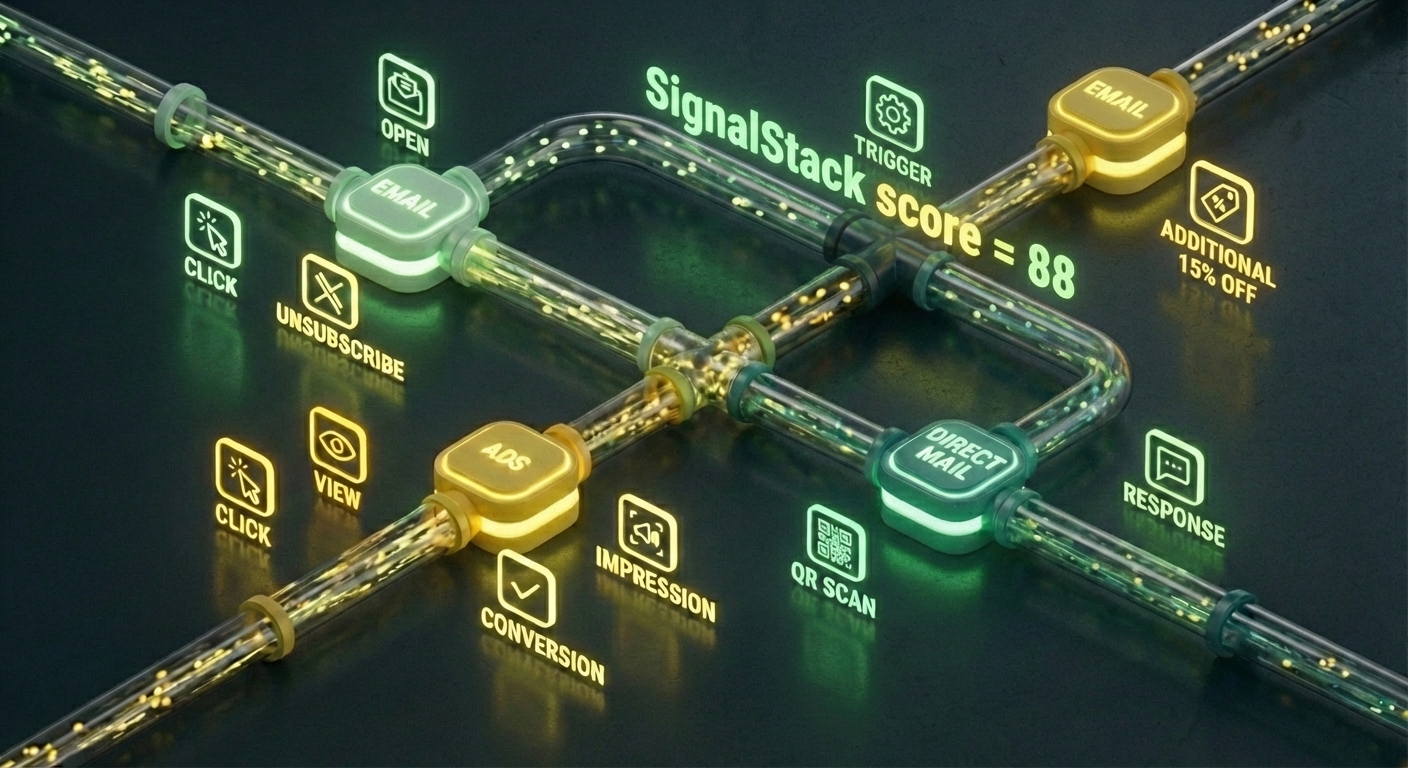
At Boostt.ai, we call this a SignalStack™: a customer signal pipeline that transforms scattered customer behaviors and brand exposures into a consistent stream of events. This unified stream is the engine that powers real-time decisioning, cross-channel orchestration, and accurate attribution.
Why Journeys Fail Without a Signal Event Backbone
Many well-intentioned journey mapping initiatives break down during execution. The beautiful flowchart on the whiteboard rarely translates into a smooth customer experience. This failure typically stems from a few core issues that a signal backbone is designed to solve:
- Inconsistent Triggers: What one team considers a “high-intent” action might be entirely different for another. Without a shared definition, journeys become a series of conflicting “if-then” statements that don’t align.
- Partial Identity: Events are often siloed within channels, making it impossible to stitch them into a coherent customer timeline. You see a web visitor, an email subscriber, and an ad audience member, but you can’t see the single person behind them.
- Incomparable Channels: How do you weigh an email click against a connected TV (CTV) impression or a direct mail piece arriving in a home? Without a common framework, you can’t make apples-to-apples comparisons to decide the next best action.
- Measurement Isn’t Event-Native: Reporting often happens after the fact, disconnected from the actions that drove it. When exposure (what you did) and response (what they did) aren’t recorded in the same model, attribution becomes a guessing game.
A SignalStack™ resolves these challenges by making your entire journey orchestration event-native. Instead of relying on static segments, you start orchestrating based on a real-time flow of customer behavior. This approach connects your strategy directly to your execution, creating a true journey decision system.
The SignalStack™ Model: Three Core Event Types
To build a powerful customer signal pipeline and orchestrate effectively across channels, you need to categorize events into three distinct types. This mental model brings clarity to the chaos of customer data.
1. Behavioral Events (What the Customer Did)
These events represent direct actions taken by the customer, signaling their intent and engagement level. They tell you what a person is interested in and where they are in their decision-making process.
- Examples: page_viewed, category_viewed, pricing_viewed, product_added_to_cart, checkout_started, quote_requested, email_clicked, sms_replied, support_ticket_opened.
2. Exposure Events (What the Brand Did)
These are the events you initiate. They are crucial for controlling message frequency and are the foundation of reliable attribution. Without tracking exposures, you can’t know which of your efforts are actually working.
- Examples: email_sent, email_delivered, email_opened, ad_impression, ad_click, ctv_viewed_50pct, mail_dropped, mail_in_home_estimated, qr_scanned.
3. Outcome Events (What the Business Got)
These events represent the key business results you are trying to achieve. They are the conversion points that anchor your ROI calculations and create the learning loops needed to optimize performance over time.
- Examples: purchase_completed, lead_submitted, appointment_booked, subscription_started, renewal_completed, churned, margin_realized.
Event Design: The Fields That Power Orchestration
A signal is only as useful as the information it contains. To create a flexible and powerful journey orchestration event framework, you must standardize the data fields attached to every event. If you only do one thing, focus on getting these fields right:
- actor_id: Your canonical identifier for a person, customer, or household. This is the key to stitching together a unified customer view.
- timestamp: The precise time the event occurred, ideally with the source system time included for debugging.
- event_name: A stable, human-readable taxonomy for event names. Avoid meaningless labels like “custom_event_47” that create confusion.
- context: Critical metadata like the device, channel, campaign, creative, and placement associated with the event.
- entity: Identifiers for the specific “thing” the event relates to, such as a product_id, category_id, store_id, or offer_id.
- value: The monetary value associated with the event, like revenue, average order value (AOV), or even predicted LTV tier.
- consent/eligibility flags: Data points that govern how you can interact with the customer, such as email_opt_in, postal_deliverable, or ad_match_eligible.
This structured approach is how you make customer segments dynamic. Instead of being static lists, segments become computed views of a customer’s event history combined with predictive insights.
Incorporating Time Decay into Signals
A critical but often overlooked element of journey orchestration is the concept of time decay. Not all signals should have the same influence over time; more recent events should weigh more heavily on triggers than actions taken in the distant past. By applying time decay to your signals, you ensure that customer journeys respond to current behaviors and intent, rather than being swayed by outdated actions.
For example, a product_added_to_cart event that occurred yesterday should have a greater impact on journey eligibility than the same event from six months ago. This approach prevents scenarios where customers are entered into journeys based on stale signals, helping you deliver more relevant and timely experiences.
When designing your triggers, build in logic to weigh signals appropriately over time. Use decay functions or recency thresholds in your event evaluation—for instance:
- Only count pricing_viewed events that occurred in the last 14 days toward a “High Intent” journey trigger.
- Apply a reduced weighting (e.g., 50%) to behavioral events more than 30 days old.
By incorporating time decay, your journey orchestration event framework becomes adaptive and responsive to real customer activity, driving smarter channel orchestration and improving conversion rates.
Turning Signals into Orchestration and Decisions
Once your SignalStack™ is in place, you can use this clean, consistent data to manage journey logic with three layers of control.
- Triggers (Entry into a journey): These are the conditions that initiate a journey, now enhanced with time decay considerations to prioritize recent, high-intent actions.
- Example: Enter a customer into the “High Intent Nurture” journey when a pricing_viewed event occurs twice in the last seven days, with older events weighing less or excluded entirely.
- Guards (Rules that prevent bad experiences): These are the safety rails that enforce your business rules and respect customer preferences.
- Example: If the email_opt_in flag is false, suppress the email and choose another channel. If frequency_last_7d exceeds the cap, delay the next touch or switch to a lower-cost channel.
- Decisions (Next best action): This is where you use the rich event data to determine the optimal next step for each individual.
- Example: If a customer’s propensity decile is in the Top 10%, allow premium touches like CTV and direct mail. If their decile is in the Bottom 50%, suppress expensive channels and test low-cost options only. This is where agentic decisioning can automate and compound your impact.
SignalStack™ and Attribution: Why Exposure Events Are Critical
Attribution models often fail because exposure is not treated as a first-class event. To get credible, cross-channel reporting that your CFO will trust, you must record every exposure (what was delivered) alongside every response (what the customer did next).
Your customer signal pipeline becomes the source of truth for measurement. By logging exposures from web, email, ads, CTV, and direct mail in the same system as behavioral and outcome events, you build a complete picture. This unified event stream is also the key to running clean holdouts and incrementality tests, finally allowing you to measure the true impact of each channel.
Getting Started: The Minimum Viable SignalStack™
You don’t need to build a perfect, all-encompassing system from day one. The key is to start small, prove value, and expand from there. A “minimum viable SignalStack(™)” could include:
- 15–30 core events: A curated list covering your most important behaviors, exposures, and outcomes.
- Canonical identity keys: Start linking events to a customer ID, even if your identity resolution is partial at first.
- A basic taxonomy: Agree on a simple data contract for naming and structuring your core events.
- A single “event-to-journey” path: Validate one complete flow, from signal capture to journey execution, to prove the concept end-to-end.
- Exposure event logging: Start by tracking exposures for at least one paid channel and your direct mail campaigns.
Once you have this foundation in place and can demonstrate its value, you can progressively expand the framework across more channels and use cases. This iterative approach builds momentum and ensures your journey orchestration event framework delivers tangible results.