

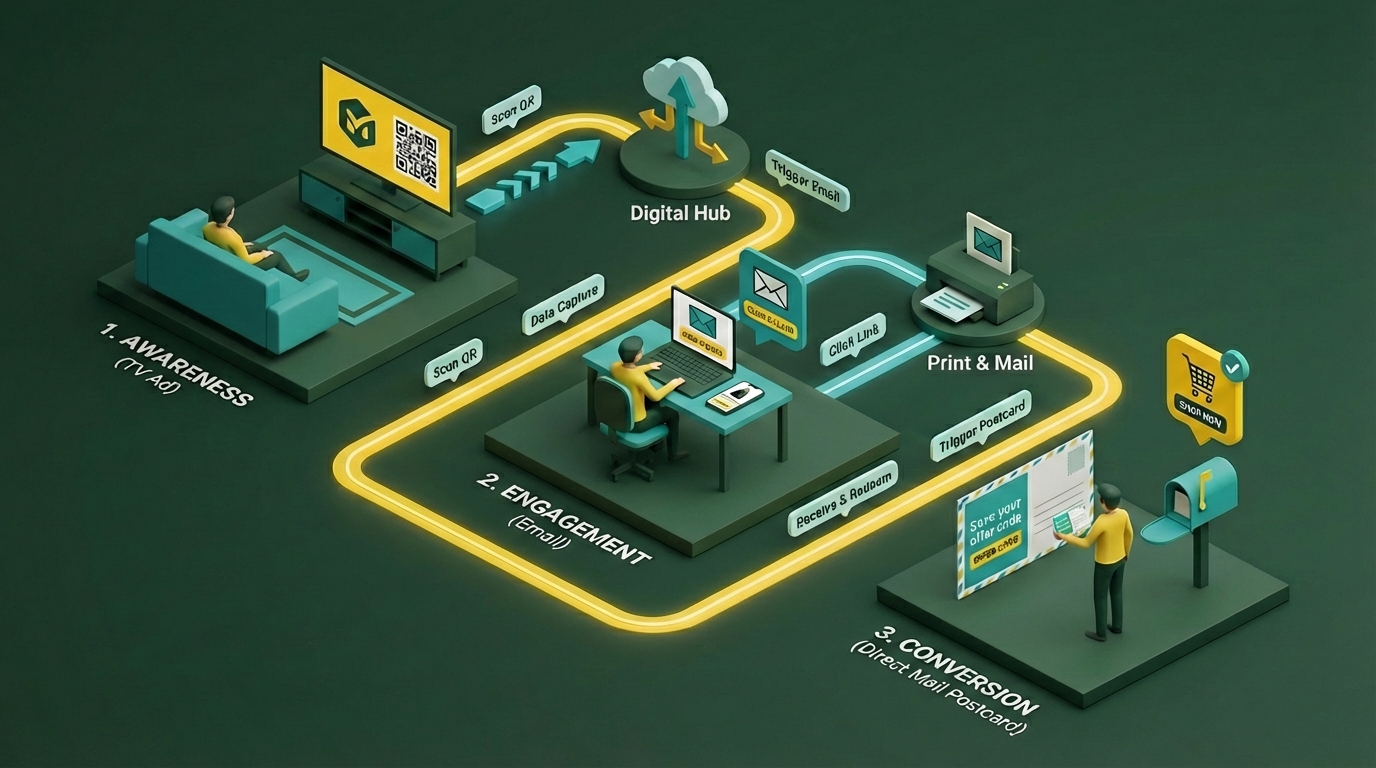

Journey mapping in marketing is the process of mapping every step and touchpoint a customer has with your brand—across digital and offline channels—to optimize the experience and drive measurable business outcomes.
At-A-Glance: What Is Journey Mapping?
Journey mapping is not just about charting emails or messages. It is a strategic process for understanding and influencing the customer journey, connecting every channel and interaction. The best journey mapping:
- Defines who to target, what action to trigger, which channel to use, and how to measure success.
- Goes beyond digital. It covers email, ads, CTV (Connected TV), direct mail, and more.
- Uses segmentation and AI to adapt quickly and deliver value.
Most “journey mapping” content assumes your world is exclusively digital. You see flowcharts of emails, push notifications, and in-app messages neatly arranged in a linear path. While these diagrams look impressive in a boardroom, they are often incomplete.
Real growth programs don’t happen in a vacuum of owned digital channels. If you are running sophisticated campaigns, you need to orchestrate omnichannel journeys that span paid and offline channels—think addressable ads, Connected TV (CTV), and direct mail. You also need to prove that these touchpoints actually work through rigorous marketing attribution and matchback analysis.
This is where journey mapping and segmentation often diverge. For some, it becomes a competitive advantage that drives revenue. For others, it turns into a never-ending exercise in drawing diagrams that never quite match reality.
This guide provides a practical, modern framework to build journeys that are predictive, omnichannel by design, and measurable end-to-end. We will move beyond static flowcharts and explore how predictive segmentation and intelligent orchestration can drive measurable incremental lift for your business.
Journey Mapping and Segmentation in the AI Era
To modernize your approach, you must first redefine what these terms actually mean. In the past, a journey map might have been a static document. Today, it must be a dynamic decision system.
Redefining Journey Mapping
A true journey map is a decision engine, not just a communication plan. It answers five critical questions:
- Who are we trying to influence? (Audience definition)
- What is the next best action? (Decisioning logic)
- Where should we deliver it? (Channel selection)
- When should we trigger it? (Timing and cadence)
- How will we measure ROI? (Attribution and experiments)
If your map is simply a sequence of messages without the underlying logic of why a customer receives them, you aren’t journey mapping—you’re just scheduling emails.
The Modern Segmentation Stack
Segmentation is the logic that determines who gets what. However, modern segmentation isn’t a single layer of demographics. It is a multi-layered stack that evolves in real-time.
- Identity & Eligibility: Who can we actually reach, and on which channels?
- Context: Where are they in the lifecycle? What are their preferences and geographic constraints?
- Intent & Behavior: What actions have they taken onsite? What signals are they sending?
- Value: What is their predicted Lifetime Value (LTV)? What is their margin and payback window?
- Propensity: How likely are they to convert, churn, or upgrade?
- Treatment Strategy: What offer level and frequency cap applies to them?
The shift here is fundamental: we are moving from static “segments” that are updated quarterly to dynamic audiences updated by live signals and AI predictions.
Why Legacy Segmentation Fails
Despite the abundance of data available, many organizations struggle to operationalize it. This failure usually stems from three specific modes.
1. Demographics Masquerading as Strategy
Age, income, and zip code are descriptive, but they rarely predict behavior. Knowing someone is a “35-year-old in Chicago” tells you very little about whether they are ready to buy. Behavior drives outcomes, yet many strategies rely solely on static profiles.
2. Channel Silos
In many enterprises, the email team runs “email journeys,” the ad team runs “ad campaigns,” and the direct mail team operates in isolation. Your customer, however, experiences one brand. When your operational stack is fragmented, the customer experience feels disjointed. Customer journey orchestration requires a unified view, not three disconnected systems battling for attention.
3. Measurement Theatre
Dashboards that show “up and to the right” metrics are comforting but often misleading. If you cannot connect exposure to response and revenue with credible attribution—and ideally holdouts—you are left with correlation, not causation. This leads to “measurement theatre,” where data looks good but doesn’t actually inform better decisions.
The Journey–Segmentation Operating Model
To fix these broken processes, use this five-layer model. It is designed to help you execute cleanly and optimize over time.
Layer 1: Objective & Economics
Start by defining the business outcome with clear constraints. What is the primary KPI? Is it revenue, margin, or retention? You must also define your unit economics, such as Cost Per Acquisition (CPA) ceilings and payback periods. Finally, establish success thresholds. What is the minimum incremental lift required to scale this journey?
Layer 2: Audience Architecture
Build segments that align directly with decisions.
- Lifecycle: Classify users as new, active, lapsing, or winback.
- Value Tiers: Differentiate between high margin, high LTV, and deal-seekers.
- Intent Tiers: Use signals and predictions to categorize intent as low, medium, or high.
- Eligibility: Determine reachability. Can you contact them via email? Are they addressable for ads or direct mail?
Layer 3: Decisioning (Predictive + Rules)
This is where modern predictive segmentation shines. Rules handle hard constraints like compliance and frequency caps. Predictions handle prioritization—determining who is most likely to respond and what they will respond to. Optimization logic then handles the tradeoffs between channel mix and timing.
Layer 4: Omnichannel Orchestration
Your journey is not just “email plus retargeting.” It is a sequenced influence across multiple touchpoints:
- Web: Personalization and real-time triggers.
- Email: Nurture, conversion, and retention sequences.
- Addressable Ads + CTV: Reach, frequency, and incremental lift.
- Direct Mail: High-impact touches with household-level targeting.
Layer 5: Measurement & Learning Loop
You cannot optimize what you do not measure. Your plan must include attribution design (identity stitching), experiment design (holdouts and geo tests), and outcome tracking (revenue and ROI by segment).
Building a Modern Segmentation Stack
Here is a blueprint for segmentation that works across industries. It moves beyond basic demographics to actionable, economic, and behavioral logic.
Lifecycle Segments (Always-On)
These define where the customer sits in their relationship with you.
- New: From first touch to first purchase.
- Active: Within a specific purchase or engagement window.
- At-Risk: Declining engagement or reduced frequency.
- Churn Risk: Predicted churn probability exceeds a safety threshold.
- Winback: Churned but still reachable and economically viable.
Value Tiers (Economics-First)
Not all revenue is equal. Segment by Predicted LTV deciles (e.g., Top 10%, Next 20%). Consider margin-adjusted value tiers and payback window tiers to ensure you are spending budget where it yields the highest return.
Intent Tiers (Signal-Driven)
Behavior indicates intent. Look at web behavior (repeat visits, scroll depth), engagement (email clicks, ad exposure), and offline signals (store visits, QR scans). Boostt AI’s SignalStack™ Index is a great example of how these intent signals can be harvested to trigger the next action.
The SignalStack™ event backbone architecture consists of behavioral events, exposure events, and outcome events tied into the same data spine.
Offer Sensitivity Tiers
Understanding what changes behavior is crucial for profitability. Distinguish between discount responders and value responders. Separate bundlers from single-item buyers. This ensures you don’t give away margin to customers who would have bought at full price.
Channel Eligibility
Finally, operational reality matters. Check email deliverability and consent status. Determine your addressable match rate for ads and CTV. Verify postal deliverability. Your segmentation should determine decisions, not just describe customers.
Execution: Build from Triggers, Not Timelines
A common mistake in journey mapping and segmentation is starting with a timeline (Day 1, Day 3, Day 7). Instead, build from triggers and states.
Step 1: Define Entry Conditions
Who enters and why? Perhaps they visited the pricing page twice in 7 days, or they are a new mover within 90 days. Maybe their predicted churn risk just spiked above 0.7.
Step 2: Define States
What is true right now? Are they “High Intent, Low Trust”? “High Value, Low Engagement”? “Price Sensitive”?
Step 3: Define Actions
Create a modular library of actions.
- Educate: Proof points, comparisons, case studies.
- Convert: Offers, urgency, reminders.
- Retain: Onboarding, value realization.
- Rescue: Winback, reactivation.
Step 4: Channel Strategy
Use the right channel for the job. Use the web for immediate feedback loops. Use email for cost-efficient sequencing. Use Ads/CTV for reach and memory reinforcement. Use direct mail for high-impact, tangible moments.
The Multiplier: Predictive Segmentation
Rules-based segmentation asks, “Does this person meet criteria X?” Predictive segmentation asks, “Who is most likely to do Y, and what is the expected value if we spend Z?”
Predictive models change the game by enabling prioritization. You can ensure top deciles get premium treatments while lower deciles get cheaper touches or are suppressed entirely. It also guides offer selection—identifying who needs a discount versus who doesn’t.
Even a simple starting model can drive huge improvements. For example, if you score customers on conversion propensity, you might target the top 10% with higher frequency and higher-cost channels. The middle 40% might receive nurture and retargeting, while the bottom 50% are suppressed to save budget.
Omnichannel Sequencing Patterns
Don’t just blast every channel at once. Use these patterns to sequence influence effectively.
Pattern 1: Web → Email → Reinforce (High Intent)
Trigger this with high-intent web behavior. Use the web for immediate personalization. Follow up with a short email sequence reinforcing value. Support this with 7–14 days of light ad reinforcement.
Pattern 2: Mail as the Moment (Offline Leverage)
Trigger this for predicted responders with deliverable postal addresses. Let direct mail be the primary conversion touch. Support it with an email pre-notice and follow-up sequence, plus a short burst of ads around the in-home window to increase recall.
Pattern 3: CTV for Memory, Email for Closure
Use this for mid-intent audiences or longer consideration cycles. Use CTV for storytelling and differentiation. Follow up with email content that provides proof and a clear call to action.
Pattern 4: Rescue & Retain (Churn Risk)
Trigger this when churn propensity crosses a threshold. Use email for value realization. Use ads for social proof reminders. Deploy direct mail only for high-value customers who need a concierge-style touch.
Attribution That Executives Trust
If you are running direct mail, ads, and email, you need marketing attribution that handles reality. This means using matchback attribution to map offline responses to online actions.
Define Conversion Events: Be clear on what counts—purchase, lead submitted, booked call.
Define Matchback Windows: Set realistic windows, such as 30 days after a mail piece arrives or 7 days after an ad exposure.
Track Exposure & Response: Monitor email opens, ad impressions, and mail delivery proxies.
Add Holdouts: Use segment-level or geo holdouts to prove incremental lift.
Report results in a way finance cares about: Incremental conversions, incremental revenue, and incremental ROI. This transforms journey mapping from a creative exercise into a growth system.
A Blueprint for Success
To operationalize this, document every journey using a standard blueprint.
- Objective: What are we solving for?
- Audience Segments: Lifecycle + Value + Intent.
- Decisioning: Rules + Propensity thresholds.
- Channel Sequence: Touches with specific triggers.
- Measurement: Attribution windows and holdout design.
By adopting this modern guide to journey mapping and segmentation, you move beyond making prettier flowcharts. You start building predictive, omnichannel journeys that drive real, measurable growth.
FAQs
What is journey mapping in marketing?
Journey mapping in marketing is the process of visualizing and orchestrating the end-to-end experience a customer has with your brand. A modern journey map goes beyond a visual diagram; it is a strategic decision framework that defines who to target, what action to trigger, which channel to use, and how to measure success across both digital and offline touchpoints.
What’s the difference between segmentation and personalization?
Segmentation is the process of grouping customers into audiences based on shared characteristics like behavior, value, or intent (e.g., “High-Value Churn Risk”). Personalization is the execution of tailoring the specific message, offer, or creative to individuals within those segments (e.g., using their name or recommending products based on past purchases). Segmentation decides who to talk to; personalization decides how to talk to them.
How do you build a lifecycle segmentation model?
To build a lifecycle segmentation model, categorize your audience based on their stage in the customer relationship. Common stages include New (first touch/purchase), Active (engaging regularly), At-Risk (declining activity), Churned (stopped engaging), and Winback (re-engagement targets). Enhance this model by layering in value tiers (LTV) and intent signals to make it dynamic rather than just time-based.
What is predictive segmentation and how is it measured?
Predictive segmentation uses AI and machine learning to group customers based on their likelihood to perform a future action, such as converting, churning, or spending a certain amount. It is measured by comparing the predicted outcome against the actual behavior. Success is typically tracked via incremental lift—showing that targeting users with high propensity scores yields better ROI than random or rules-based targeting.
How do you attribute results across email, ads, CTV, and direct mail?
Attributing results across these channels requires matchback attribution and identity resolution. You must link digital identifiers (cookies, emails) with offline data (household addresses). By setting specific attribution windows (e.g., 30 days post-mail) and tracking conversion events back to the individual level, you can see which combination of touchpoints contributed to the final sale.
What is matchback attribution and when should you use it?
Matchback attribution is a measurement technique used to credit offline marketing channels (like direct mail) for online conversions. It matches a transaction record (who bought) back to the original mailing list (who was sent mail). You should use it whenever you run offline campaigns that drive traffic to a website, ensuring you capture the true ROI of your non-digital spend.