



Most eCommerce platforms operate on a fundamental assumption: shoppers will do all the work. They are expected to search, filter, compare products, second-guess their choices, and navigate a complex path to purchase. This model may have worked when online catalogs were small and customer attention was easy to capture, but it’s no longer effective.
Today’s shoppers are overwhelmed by infinite choices. The traditional “conversion playbook” has become a fragmented collection of tools that rarely work together seamlessly. The solution isn’t just a smarter chatbot. The future is agentic commerce—intelligent systems that can understand intent, decide on the best action, execute it, and learn from the results to improve the KPIs that matter most to merchants.
This process can be visualized as a continuous loop, integrating three key stages into one cohesive operating model:
- Product Discovery
- Customer Engagement
- Omnichannel Follow-up
The Two Shifts Driving Agentic Commerce
Two significant shifts are happening right now that are paving the way for this new era of commerce.
1. Shopping is Moving to Conversational Interfaces
Foundation models are becoming increasingly adept at helping people explore and compare products using natural language. As this technology improves, product discovery through chat will become a standard part of the shopping experience.
2. The Rails are Becoming Standardized
Google’s Universal Commerce Protocol (UCP) is a strong indicator that interactions between agents and commerce systems are moving toward a more standardized framework. Standards are crucial because they reduce friction, and reduced friction accelerates adoption.
However, standards alone don’t guarantee a sale. They simplify the process of connecting different systems, but they don’t automatically improve your store’s conversion rate. The real opportunity lies not just in product discovery, but in personalized conversion.
Why Personalized Conversion is the Real Opportunity
A generic AI can perform many useful tasks, such as answering product questions, comparing features, summarizing reviews, and recommending options. While helpful, these capabilities won’t be a differentiator for long.
Merchants succeed when their systems improve tangible business outcomes, including:
- Conversion rate
- Average Order Value (AOV)
- Customer retention and repeat purchases
- Customer Acquisition Cost (CAC) efficiency
- Reduction in returns
- Margin-aware upselling and cross-selling
Achieving these outcomes requires more than just generic chat. It demands a system built on context, orchestration, measurement, and clear guardrails.
The Agentic Commerce Loop in Action
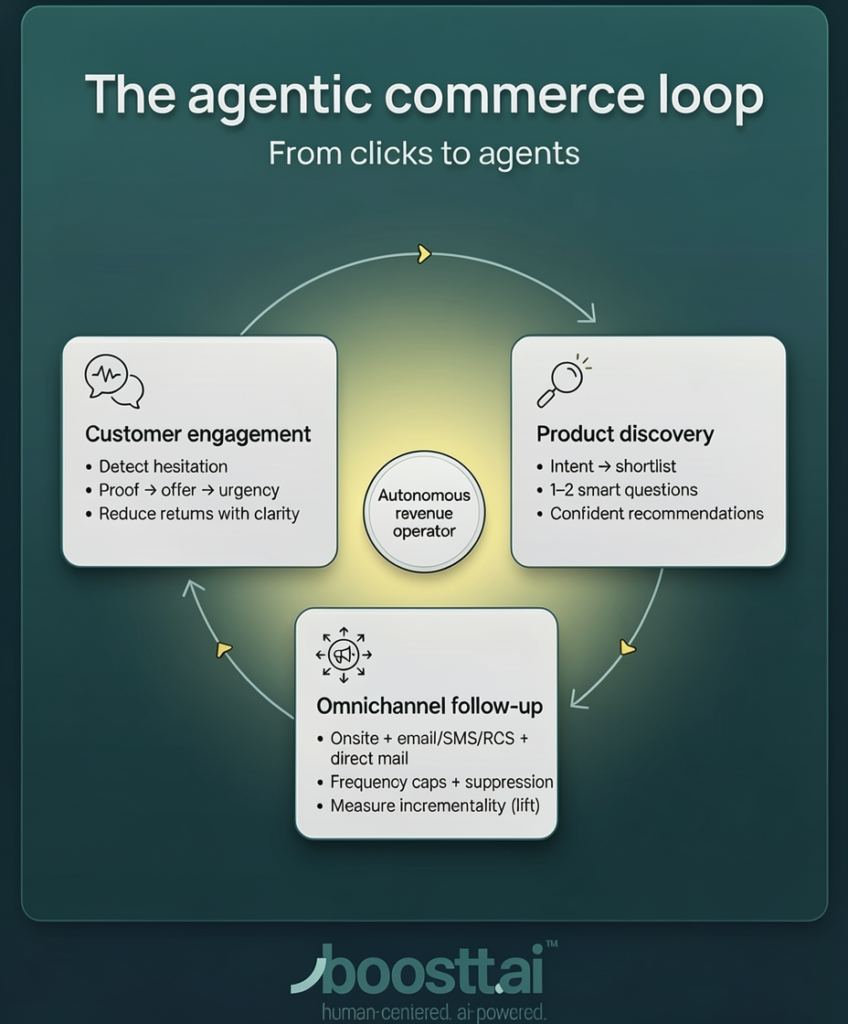
Let’s break down how this continuous loop functions at each stage to drive better results.
Loop 1: Product Discovery
Many shoppers abandon their carts not because they don’t want to buy, but because they can’t make a decision. An effective discovery agent overcomes this by reducing decision friction.
It should be able to:
- Translate a shopper’s vague intent into a concise list of options.
- Ask one intelligent clarifying question instead of ten.
- Explain the tradeoffs between products in simple terms.
- Confidently recommend the best-fit product.
- Respect business constraints like inventory, shipping, and margin rules.
Discovery is just the beginning. The next stage is proactive engagement.
Loop 2: Customer Engagement
Unlike passive assistants that wait for a question, a true agentic system should detect hesitation and intervene at the perfect moment.
- Sizing concerns? Offer fit guidance and set clear expectations.
- Comparing products? Provide a side-by-side comparison with social proof.
- Repeat visits? Offer reassurance and a tailored nudge.
- Price sensitivity? Suggest bundles, subscription options, or alternative products.
This is how you convert uncertainty into a confident purchase without resorting to constant discounts.
Loop 3: Omnichannel Follow-up
This is what separates a production-ready system from a simple demo. The agent’s work shouldn’t end when the shopper leaves your website. While most “omnichannel” marketing relies on a fixed calendar, agentic commerce makes it trigger-driven and dynamic.
- A shopper engages onsite, then gets retargeted with relevant social proof.
- High-intent behavior triggers a follow-up message within 24-48 hours.
- A conversion happens, and all related campaigns are suppressed immediately.
- No engagement leads to a lower-frequency nurture sequence.
When execution is coordinated and measurable across all channels, this loop becomes a powerful growth engine.
What Autonomous Really Means in Commerce
“Autonomous” doesn’t just mean a system that can chat. It means a system that continuously runs a full operational loop:
Observe → Decide → Execute → Experiment → Measure → Improve.
This framing is vital because it describes what merchants truly need: an autonomous revenue operator, not just another UI widget.
At Boostt, we are building the Boostt Agentic Commerce platform on this principle. It observes real shopper behavior, decides the next-best action, and executes experiments across channels to drive measurable, incremental growth. It’s a production-grade system with margin-aware decisioning, compliance governance, and incrementality measurement, allowing merchants to scale personalization without creating chaos and leaving margin on the table.
Why Most AI Demos Fail in Production
Many agent demos look impressive but fail when deployed in a real-world environment for predictable reasons.
1. No Durable Memory
If the system’s only memory is the current chat window, it loses continuity, relevance, and ultimately, the customer’s trust. A robust system needs durable state that includes intent signals, session context, user preferences, and product truth.
2. No Guardrails
An agent that can take actions—like sending messages or offering discounts—needs clear rules. This includes promo governance, compliance constraints, frequency caps, and suppression logic to protect your brand and margins.
3. No Proof of Impact
If you can’t connect the agent’s decisions to business outcomes, you have a cool feature that doesn’t move the needle. Merchants need a scoreboard that tracks incremental lift in conversion, revenue, AOV, and retention. This is what makes an agent truly accountable.
Three Practical Next Steps for Merchants
If you’re an eCommerce operator wondering how to get started, here is a practical path forward.
1. Make Your Catalog AI-Ready (1–2 Weeks)
This foundational step is non-negotiable. An agent without structured data will confidently make mistakes. Ensure you have:
- Consistent product attributes (size, fit, use case, materials).
- Coherent variants and bundles.
- Clear inventory and policy rules.
- Basic margin bands for products.
2. Define Your “Decision Moments” (1 Week)
Stop thinking about website pages and start thinking about the moments where shoppers hesitate. Identify five key moments, such as a first-time browse, a repeat visit to a category, or cart hesitation. For each moment, define the signal, what the shopper needs, and the desired next action. This will be your agent’s playbook.
3. Run a Controlled Pilot (4–8 Weeks)
Don’t just “launch a chatbot.” Run a controlled pilot with a clear scoreboard focused on business outcomes like conversion and AOV lift. Choose one category, define success thresholds, use a holdout group to measure incrementality, and iterate weekly. Your goal is to prove profitable lift, not just that AI is impressive.
The Future of Commerce
Foundation models will continue to improve, and protocols like UCP will standardize agent-to-commerce interactions. But the merchants who thrive won’t be those who simply “add AI.” The winners will be those who build a complete operational loop: intent → decision → execution → measurement → learning, all guided by guardrails that protect their brand and profitability.
Commerce is moving from clicks to agents. This shift presents a massive opportunity for merchants who treat agents not as a feature, but as the core of their operating system.
We are selectively accepting a handful of amazing Shopify merchants for our launch. See if you fit our criteria and join the wait list here.